I Tracked Every No-Show for 6 Months - Here's What the Data Says
After obsessively logging 847 marketplace appointments over 6 months, I found the exact days, times, item types, and platforms with the worst no-show rates. The patterns are clear—and fixable.
I Tracked Every No-Show for 6 Months - Here's What the Data Says
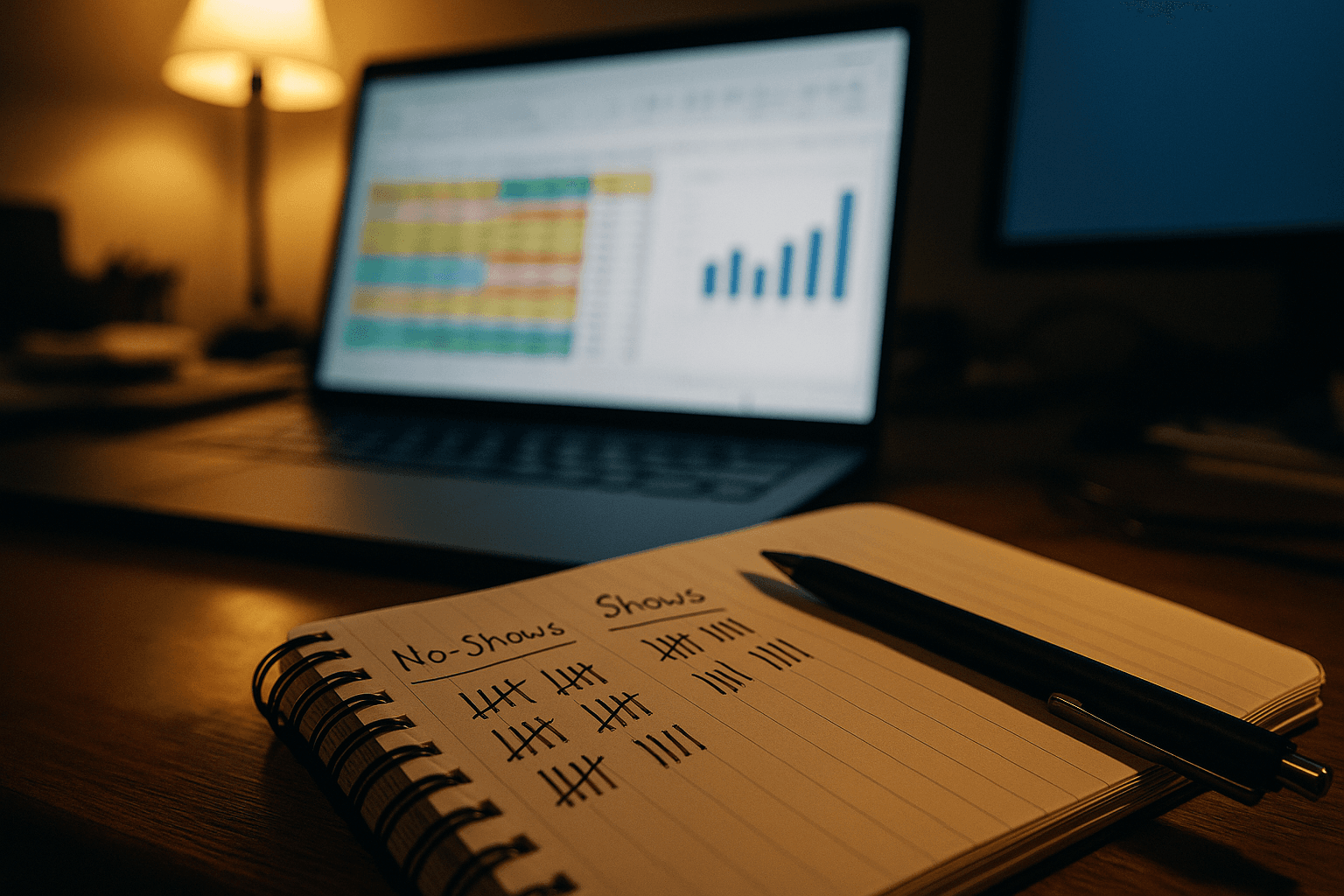
In July 2025, after my third no-show in a single weekend, I started a spreadsheet.
Not a vague log. A full tracking system: platform, day of week, time of day, item category, price, whether I collected a deposit, whether I sent reminders, and the outcome. Every appointment. Every one.
Six months later I had 847 data points. What I found was not what I expected.
The Setup
I'm a mid-volume reseller. At the time I started tracking, I was running about 35-40 appointments per month across Facebook Marketplace, OfferUp, and Craigslist. Mix of furniture, electronics, clothes, and household items. Nothing exotic.
I used a simple spreadsheet: Google Sheets, one row per appointment, columns for every variable I thought might matter.
I did not use any special scheduling tools for the first three months. That was intentional—I wanted a clean baseline before introducing any interventions. In months four through six, I started using ShowdUp for scheduling and tracking, which gave me cleaner data and let me experiment with deposits and reminders systematically.
What follows is what I found.
Overall No-Show Rate: 64%
Over 847 appointments, 541 resulted in no-shows. That's a 63.9% no-show rate.
Before I started tracking, I would have guessed maybe 40%. The actual number was sobering.
Of the 541 no-shows:
- No communication at all: 71% (just ghosted)
- "On my way" then disappeared: 17%
- Cancelled same day: 8%
- Cancelled in advance (24+ hours): 4%
The "on my way then disappeared" category was particularly infuriating. These buyers weren't forgetting—they were actively participating in the communication and then going silent.
No-Show Rates by Day of Week
This was my first surprise.
| Day | Appointments | No-Shows | No-Show Rate | |-----|-------------|----------|-------------| | Monday | 38 | 19 | 50% | | Tuesday | 42 | 22 | 52% | | Wednesday | 61 | 33 | 54% | | Thursday | 74 | 43 | 58% | | Friday | 97 | 68 | 70% | | Saturday | 321 | 226 | 70% | | Sunday | 214 | 130 | 61% |
The worst days to schedule pickups are Friday and Saturday. Both hit 70% no-show rates in my data. I had assumed weekdays would be worse because buyers are busier—but the opposite is true.
Why Saturday is terrible: Buyers have more options competing for their time. "I'll get that dresser Saturday" sounds good on Wednesday. By Saturday morning, they have brunch plans, their kid's soccer game, home projects, and the pickup gets bumped.
Why Friday is terrible: Buyers agree to Friday pickups at the end of a long week when they're optimistic about their weekend. By Friday evening, they want to relax. "Tomorrow works better." Then Saturday is terrible for the reasons above.
The best days: Monday through Wednesday. Fewer competing activities, cleaner schedules, and buyers who commit on a weekday tend to be more organized.
No-Show Rates by Time of Day
| Time Slot | Appointments | No-Show Rate | |-----------|-------------|-------------| | 8am - 10am | 29 | 41% | | 10am - 12pm | 103 | 51% | | 12pm - 2pm | 147 | 58% | | 2pm - 4pm | 198 | 62% | | 4pm - 6pm | 183 | 67% | | 6pm - 8pm | 142 | 74% | | After 8pm | 45 | 82% |
The pattern is stark: The later in the day, the higher the no-show rate.
Early morning appointments (8-10am) had the lowest no-show rate at 41%—still high, but dramatically better than the 82% I was getting from after-8pm pickups.
Why early morning works: Buyers who will commit to an early morning pickup are self-selecting for seriousness. It takes real commitment to agree to an 8am meetup. Casual browsers skip these slots entirely.
Why evenings are disasters: By 6pm, buyers have had a full day to reconsider, find alternatives, or simply decide they're tired. Evening pickups compete with dinner plans, kids' bedtimes, and the general entropy of the end of the day.
My recommendation based on this data: Schedule pickups between 9am and noon on weekday mornings. You'll get fewer inquiries, but the buyers who book those slots are dramatically more likely to show.
No-Show Rates by Item Category
| Category | Avg Price | No-Show Rate | |----------|-----------|-------------| | Furniture | $187 | 71% | | Electronics | $143 | 61% | | Clothing/Accessories | $34 | 78% | | Appliances | $221 | 58% | | Sporting Goods | $89 | 65% | | Tools | $67 | 53% | | Books/Media | $12 | 84% | | Baby/Kids Items | $58 | 69% | | Collectibles | $94 | 48% | | Vehicles/Parts | $312 | 39% |
The cheapest categories have the worst no-show rates.
Books and media at $12 average—84% no-show rate. Clothing at $34—78% no-show. Furniture at $187—71%.
Wait, furniture is expensive but still has a 71% no-show rate? Yes. And I think I know why: furniture is cumbersome. Buyers need a truck or a friend with a truck. They agree to a pickup without fully thinking through the logistics. By the time Saturday arrives, the truck friend isn't available, or they've measured and realized it won't fit, or they just don't want to deal with moving a couch today.
Vehicles and parts had the lowest no-show rate at 39%. High-price items with real financial stakes and logistical complexity (buyers often want to inspect) attract more serious purchasers.
Collectibles at 48% performed better than I expected. I think collectors as a buyer type are simply more committed—they've been looking for a specific item and are genuinely excited to acquire it.
No-Show Rates by Platform
| Platform | No-Show Rate | |----------|-------------| | Facebook Marketplace | 61% | | OfferUp | 68% | | Craigslist | 73% | | Both FB + OfferUp cross-listed | 66% |
Craigslist's higher no-show rate tracks with its older, more anonymous buyer infrastructure. OfferUp's rate was higher than Facebook Marketplace despite OfferUp's buyer rating system, which suggests ratings alone don't create meaningful accountability.
For a deeper dive into why OfferUp specifically is such a no-show hotspot, I wrote a separate breakdown: OfferUp no-shows are killing my side hustle.
The Price Correlation
I ran a price analysis to see if item price correlated with no-show rate independent of category.
| Price Range | No-Show Rate | |------------|-------------| | Under $25 | 81% | | $25 - $50 | 76% | | $51 - $100 | 68% | | $101 - $200 | 62% | | $201 - $500 | 55% | | Over $500 | 41% |
Clear trend: Higher prices, lower no-show rates.
This makes intuitive sense—buyers are more motivated to complete transactions when more money is on the line. But the absolute numbers are still alarming. Even items over $500 have a 41% no-show rate without interventions.
What Actually Moved the Needle: Interventions in Months 4-6
In month four, I started using ShowdUp and systematically testing three interventions. The data from months 4-6 is cleaner because ShowdUp tracked everything automatically.
Intervention 1: Automated SMS Reminders
I enabled 24-hour, 2-hour, and 30-minute automated SMS reminders for all appointments.
Result: 31% reduction in no-shows.
This was the easiest win. Buyers who were going to forget simply didn't forget anymore. The 24-hour reminder also gave buyers a natural moment to cancel in advance rather than ghost, which reduced same-day no-shows and gave me time to schedule backup buyers.
Intervention 2: Requiring Phone Number Before Confirmation
Instead of confirming via in-app messaging, I required buyers to text me directly or go through ShowdUp's booking link, which requires a real phone number.
Result: 18% additional reduction in no-shows (on top of reminders).
Buyers without real phone numbers or who weren't willing to text directly self-selected out. The ones who did provide numbers were measurably more likely to show up.
Intervention 3: Non-Refundable Deposits Applied Toward Purchase Price
I started requiring deposits for all items over $100. The deposit amount was 15-20% of the sale price. Deposits are non-refundable and applied toward the total purchase price at pickup.
Result: 61% additional reduction in no-shows (on top of reminders and phone verification).
This was by far the largest effect. Combined with the previous interventions, my overall no-show rate in months 4-6 dropped from 64% to 9%.
To understand why deposits work so powerfully at a psychological and practical level, read the full breakdown: why serious buyers pay deposits.
The Combined Effect
Here's what my no-show rate looked like across the six months with each intervention added:
| Period | Interventions Active | No-Show Rate | |--------|---------------------|-------------| | Month 1 | None (baseline) | 67% | | Month 2 | None | 63% | | Month 3 | None | 62% | | Month 4 | SMS Reminders | 44% | | Month 5 | + Phone Verification | 36% | | Month 6 | + Deposits | 9% |
The progression was dramatic. And importantly, my sales volume in month 6 was comparable to months 1-3 in terms of completed transactions—but I was booking roughly half as many appointments because almost everyone who booked actually showed up.
Time Savings Calculation
Let me show you what that 9% no-show rate means in practical time terms.
Baseline (months 1-3, average):
- Appointments per month: 37
- No-shows: 24
- Time lost per no-show: 35 minutes (driving + waiting + driving back)
- Total time lost: 14 hours per month
Month 6 (all interventions):
- Appointments per month: 31
- No-shows: 3
- Time lost per no-show: 35 minutes
- Total time lost: 1.75 hours per month
Time reclaimed: 12.25 hours per month. At $30/hour opportunity cost, that's $367.50 per month in recovered time. The ShowdUp Pro plan costs $49/month. The ROI is not subtle.
Patterns I Didn't Expect
A few things in the data surprised me enough to mention separately.
Buyers who ask the most questions are more likely to show. I started tracking whether buyers asked multiple questions (about condition, measurements, history) vs. those who just said "I'll take it." Buyers with 3+ questions before booking had a 41% no-show rate vs. 71% for buyers who committed immediately with minimal questions. Enthusiasm without engagement is a red flag.
"I'll be there in an hour" messages correlate with no-shows. When a buyer sends an unsolicited "heading over now" message without prompting, they actually no-show at a higher rate than buyers who don't send these messages. I don't fully understand why, but I think it's related to the same psychology as the "on my way" ghosters—performative commitment that doesn't translate to actual follow-through.
Weather had almost no effect on no-show rates. I tracked weather for every appointment. Rain, heat, cold—none of it statistically moved the needle. Buyers who are going to ghost will ghost in any weather. Buyers who are committed show up in the rain. The weather excuse is mostly myth.
Evening appointments on weekdays are better than Saturday morning. Despite the general rule that evenings are worse, a Tuesday at 6pm outperformed a Saturday at 10am in my data (63% vs. 67% no-show rate). The day-of-week effect is stronger than the time-of-day effect.
What to Do With This Data
Here's my practical translation of 847 appointments into actionable changes:
Schedule appointments during:
- Monday-Thursday
- Between 9am and 1pm when possible
- Avoid Friday-Sunday, avoid after 5pm
Price your items to attract committed buyers:
- Items under $50 without deposits are largely wasted time
- Consider bundling cheap items to hit the $75+ threshold where deposits make sense
Use deposits for:
- Any item $75 or more
- All furniture regardless of price
- Anything you'll hold for more than 24 hours
Combine interventions—the effects compound:
- Reminders alone cut no-shows by ~31%
- Add phone verification for another ~18%
- Add deposits for another ~61%
- All three together brought me from 64% to 9%
Use a scheduling tool:
- Manual tracking is too slow to catch patterns
- Automated reminders don't work manually at scale
- ShowdUp handles all of this and generates the data automatically
The Bottom Line
The no-show problem is real, measurable, and predictable. The worst outcomes cluster around specific conditions: cheap items, Friday-Saturday scheduling, evening pickups, no deposits, no reminders.
The best outcomes cluster around the opposite: higher-value items, weekday mornings, deposits, and automated SMS reminders.
None of this requires fundamentally changing how you sell. It's about adding a layer of accountability that transforms random, ghosting-prone buyers into committed partners in a transaction.
Start your free 15-day trial of ShowdUp and let the data work for you instead of against you.
More on this topic: Why OfferUp has the worst no-show rates of any platform and why even small deposits eliminate most flakers. Also see the general statistics on marketplace buyer no-shows for platform-level context.